The History of Birmingham's Jewellery Quarter: A Journey Through Time

Claudia is a fine jewellery marketing specialist who fuses literary precision with strategic insight to craft compelling content to engage and guide our audience – from first-time proposers to brides-to-be, and beyond.

Birmingham from the Dome of St Philip's Church in 1821 / Samuel Lines Snr
Tucked within a single square mile of Birmingham lies one of the most important jewellery hubs in the world. The Birmingham Jewellery Quarter has been at the heart of British jewellery making for more than 250 years. Remarkably, this historic square mile still produces around 40% of the UK’s jewellery, making it one of the most important jewellery manufacturing districts in the world.
Today, the Quarter is home to hundreds of independent jewellers, specialist workshops and skilled craftspeople. Walking through its streets reveals centuries of expertise, where traditional techniques sit alongside modern jewellery design. But how did this small corner of Birmingham become such a powerhouse of jewellery making? To understand its significance today, we need to look back to the late 18th century, when the foundations of the Jewellery Quarter were first laid.

What is the Birmingham Jewellery Quarter?
The Birmingham Jewellery Quarter is one of the world’s largest and most historic jewellery districts, located just outside Birmingham’s city centre. For centuries, it has been a centre for jewellery manufacturing, bringing together skilled craftspeople, specialist workshops and independent jewellers within a remarkably concentrated area.
Unlike many historic craft districts, the Jewellery Quarter isn’t simply a preserved landmark – it’s a living industrial community. Hundreds of independent jewellers, goldsmiths, gemmologists and specialist workshops continue to design, craft and repair jewellery here every day, keeping traditional skills alive alongside modern techniques.
In recognition of this heritage and ongoing craftsmanship, the area was officially named a World Craft City in 2025, joining a global network of locations celebrated for their excellence in artisan skills and cultural craft traditions.
Today, the district blends historic workshops with contemporary jewellery studios and showrooms. Sitting close to the gateway of this historic area, Queensmith’s Birmingham showroom forms part of the modern extension of the Jewellery Quarter, connecting clients with the same tradition of craftsmanship that has defined the district for generations.

History of the Birmingham Jewellery Quarter: A Timeline
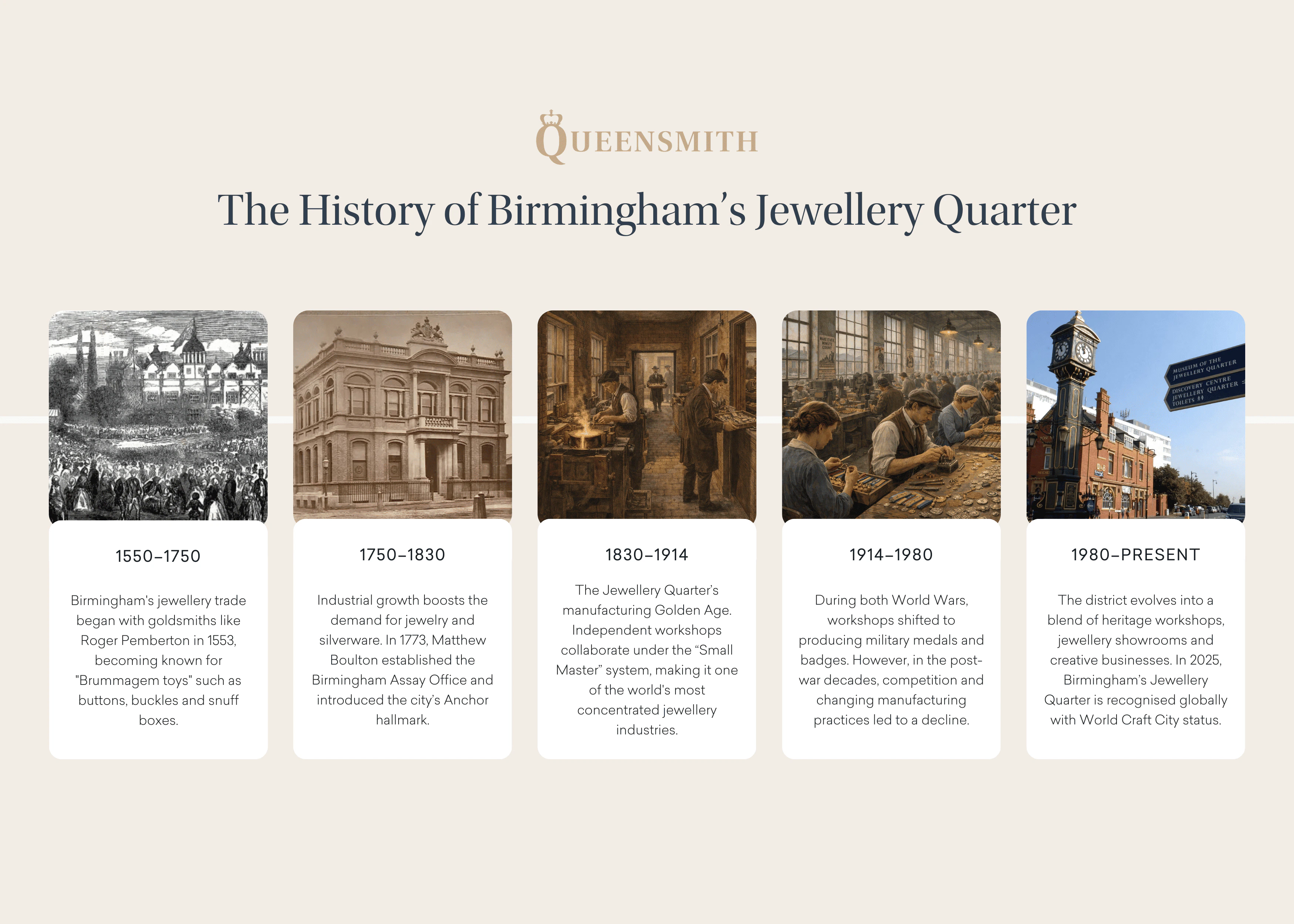
1550–1750: The Early Trade and “Brummagem Toys”
The roots of Birmingham’s jewellery trade stretch back to the 16th century, when early records show skilled metalworkers operating in the town. One of the earliest known goldsmiths was Roger Pemberton, documented in 1553, marking the beginnings of Birmingham’s reputation for metal craftsmanship.
By the 17th and early 18th centuries, the town had become famous for producing small decorative metal items known as “Brummagem toys.” Despite the playful name, these “toys” were not children’s playthings. Instead, they referred to small personal metalware such as buttons, buckles, snuff boxes and decorative fittings, crafted in brass, steel and precious metals.

Image from Birmingham Assay Office. Brummagem toy example: an engraved snuff box made by Samuel Pemberton in 1788.
At the same time, Birmingham was expanding rapidly. The Colmore family estate began developing land to the north-west of the town, laying out St Paul’s Square in the 1770s as a Georgian residential square. Designed for affluent residents, its elegant townhouses soon proved well suited to small workshops. As Birmingham’s jewellery trade grew, many of these homes were gradually adapted for manufacturing, with craftsmen converting basements, attics and rear outbuildings into working studios. This blend of residential architecture and small-scale industry helped establish the foundations of what would later become the Jewellery Quarter.

Depiction of St Paul’s Square, developed in the 1770s on the Colmore family estate
1750–1830: The Industrial Revolution and Legal Authority
The late 18th century marked a turning point for Birmingham’s jewellery industry. As the Industrial Revolution accelerated, the demand for jewellery, silverware and decorative metal goods increased dramatically. Birmingham’s skilled manufacturers were producing jewellery at a scale unmatched elsewhere in Britain.
However, with growth came a problem: Birmingham makers lacked an official authority to verify precious metals. At the time, items had to be sent to assay offices in London, Chester, Exeter or York, slowing production and increasing costs.
Industrialist Matthew Boulton, one of Birmingham’s most influential entrepreneurs, led the campaign to change this. His lobbying efforts resulted in the 1773 Act of Parliament, which established the Birmingham Assay Office and granted the city the legal authority to hallmark precious metals.
The Birmingham mark became the Anchor hallmark, chosen after a famous coin toss at the Crown & Anchor tavern in London between representatives of Birmingham and Sheffield. Birmingham claimed the anchor, while Sheffield adopted the crown. The decision cemented Birmingham’s status as a recognised centre for precious metal manufacturing.

Depiction of Birmingham's Assay Office, established in 1773
1830–1914: The Industrial Peak and the “Small Master” System
By the 19th century, the Jewellery Quarter had entered its industrial Golden Age. As the Industrial Revolution reached full momentum, the district evolved into a dense network of specialist workshops and manufacturers.
At the heart of this success was the “Small Master” system. Rather than large centralised factories, production was divided among independent specialist craftspeople, each responsible for a specific stage of jewellery making. One workshop might focus on casting, another on engraving and another on stone setting.
Many of these operations took place in tiny back-garden workshops known locally as “shopping.” These compact spaces formed a tightly connected ecosystem where skills, materials and expertise flowed between neighbouring workshops.
The scale of the industry was remarkable. By 1913, the Jewellery Quarter employed around 70,000 people, making it one of the most concentrated centres of jewellery manufacturing anywhere in the world.
One example of this thriving industrial network was the JW Evans Silver Factory on Albion Street. Founded in 1881 by Jenkin William Evans, the workshop produced a wide range of silverware, from tableware and jewellery to novelty items. Like many businesses in the Jewellery Quarter, it operated as a relatively small family-run manufacturer rather than a large factory.
During the late 19th and early 20th centuries, Evans supplied silver components and finished pieces to prestigious retailers, reflecting the district’s reputation for high-quality craftsmanship. At its peak in the years before the First World War, the factory employed dozens of skilled workers producing thousands of metal components each year.

Fly press operators at JW Evans, photographed around 1910 / English Heritage
1914–1980: Wartime Resilience and Post-War Decline
The outbreak of the First World War brought major changes to the Jewellery Quarter. Many workshops shifted from jewellery production to war work, manufacturing military badges, medals, buttons and munitions components. This transformation happened again during the Second World War, demonstrating the district’s adaptability during times of national need.
After the war, however, the Quarter began to experience a gradual industrial decline. Changing manufacturing practices, global competition and the movement of large-scale production overseas reduced the number of traditional workshops operating in the area.
A symbolic moment came in 1981, when the long-running Smith & Pepper jewellery factory closed its doors after more than a century of operation. Rather than dismantling the workshop, its owners left everything exactly as it was – tools, benches and unfinished work still in place.
The building was later preserved as the Museum of the Jewellery Quarter, creating a remarkable time capsule of traditional jewellery manufacturing. Its preservation marked an important shift, helping to protect the area’s heritage while opening the district to visitors and cultural tourism.

Depiction of a mid-20th-century jewellery workshop, inspired by the Smith & Pepper factory
1980–Present: Modern Revival and World Craft City Status
From the 1980s onwards, the Jewellery Quarter began a gradual transformation. While manufacturing remained central to the district, new businesses emerged alongside traditional workshops. Independent jewellers opened direct-to-client showrooms, and creative industries moved into restored historic buildings.
This regeneration helped re-establish the Quarter as both a working jewellery district and a cultural destination. Visitors could now explore museums, galleries, historic streets and contemporary jewellery studios within the same square mile. It has also become a meaningful setting for life’s biggest moments, with many choosing the area, or nearby locations, when deciding where to propose in Birmingham.
The area’s international significance was recognised in June 2025, when Birmingham’s Jewellery Quarter was officially designated a World Craft City. This status places it among globally celebrated craft centres such as Kyoto, recognising the district’s enduring contribution to jewellery craftsmanship and artisan skills.
Today, the story of the Jewellery Quarter continues to evolve. While the historic workshops remain at its heart, new showrooms and jewellery businesses located just beyond the traditional boundaries represent the modern outward expansion of the district’s craftsmanship, bringing its centuries-old expertise into a contemporary retail experience.
Bringing the Tradition to Queensmith
While the history of Birmingham’s jewellery trade is centred within the historic core of the Jewellery Quarter, the industry itself has never stood still. For centuries, workshops, designers and jewellers have expanded beyond the original boundaries as the trade has evolved and grown.
Today, that legacy continues. Queensmith’s Birmingham showroom is located just a short walk from the traditional boundary of the Jewellery Quarter, placing it right beside the district that shaped Britain’s jewellery industry. Explore our complete guide to the Birmingham Jewellery Quarter for all the information you need before you visit.
Queensmith's showroom location at St Philip's Place offers visitors the best of both worlds. You can still experience the same Birmingham-hallmarked standards, with craftsmanship and jewellery expertise that the Jewellery Quarter is known for, but in a space designed to feel more accessible and modern. Our showroom provides a calm, welcoming space where you can explore engagement rings, wedding rings and bespoke jewellery with guidance from experienced specialists.
If you’re planning your next steps, whether that’s choosing the perfect ring, exploring the best wedding venues in Birmingham or visiting some of the top bridal shops in Birmingham, we’re here to help you start that journey with confidence.
Book an appointment with our team and discover expertly crafted jewellery in a relaxed, contemporary setting.


Find your perfect engagement ring
Explore our curated collection of expertly crafted engagement rings – where exceptional quality meets timeless design. Every detail considered, every finish flawless.
Ready to find your ring style?