Moissanite vs Diamond Comparison Guide

A gemmologist with decades of experience and multiple qualifications, Eddi revels in creating unique jewellery designs with his clients. Influenced by his time in Glasgow, NYC and South America, he brings a wordly perspective in his approach to jewellery design.
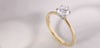
Both moissanite and diamond are hard enough to wear every day, so either can last a lifetime in an engagement ring. Diamond is the harder of the two – 10 on the Mohs scale against moissanite's 9.25 – so it resists scratches and wear better over decades, and it keeps the crisp, white sparkle that moissanite can't quite match.
If you're weighing up a moissanite engagement ring against a diamond, it helps to look past the price tag at how each stone looks, how it's made and how it will wear over the years. Here's how they compare, with insight from Queensmith's gemmologists to you.
In this article
What is a moissanite diamond?
There’s no such thing as a moissanite diamond – moissanite and diamonds are two different gemstones, and while they have visual similarities, there are some major differences between the two.
While moissanite is a potential alternative to a traditional diamond, you’ll need to carefully consider its characteristics before making that choice.
What is moissanite?
Moissanites were first found in 1893 by a French scientist called Henri Moissan. Initially he mistakenly thought they were diamonds. On later inspection, the particles Moissan found from a meteorite crater in Arizona were in fact silicon carbide - which look similar to diamond, although most trained and untrained eyes could tell moissanite apart from diamond.
While moissanites can naturally occur, they are incredibly rare to come across, meaning almost all moissanite stones are created in a laboratory for low cost jewellery.
What is a diamond?
A diamond is a naturally occurring crystalline mineral composed primarily of carbon. It is renowned for its exceptional hardness, brilliance, and exceptional visual properties. These precious gemstones are mined from underground sources or extracted through diamond mining processes and are then cut and polished to enhance their brilliance.
Diamonds can also be grown in a lab to the exact same specifications as those found in nature.
Diamonds are highly valued (and popular) in jewellery for their rarity, long-lasting quality, and symbolic significance as a representation of love and commitment.
Is moissanite a diamond?
Despite natural moissanite now being lab-grown due to its rarity, it would not be classified as a diamond, but instead a “diamond simulant”. Simulated diamonds (or synthetic diamonds) are created to look similar to diamonds but do not have the same chemical and physical properties. Other examples of synthetic diamonds are Cubic Zirconia (CZ) and white gemstones such as Sapphire, Topaz and Quartz. Most people can tell a diamond simulant apart from a real diamond, because they emit a different sparkle and their facets look less crisp than diamonds.
Can you tell diamonds and moissanites apart?
The best way to compare diamonds and moissanites is to compare them side by side. Looking closely, you’ll notice they each have a different brilliance or ‘sparkle’. Diamonds sparkle with a distinct brilliance of:
light reflection (how light bounces off the diamond)
colour refraction (the change in the direction of light when it passes through an object)
scintillation (the flash or sparkle of light)
Another way to tell moissanite from diamonds is that a real diamond will also feel cold to the touch, and won’t fog up easily when you breathe over it. Most people can tell the difference between moissanite and diamonds with the naked eye, but if you’re unsure, speak to a gemmologist for an expert view.
Moissanite, on the other hand, can look yellow or grey tinted under certain lights and has more colour and fire, flashing with vibrant rainbow hues when you rotate the stone around, showcasing a “disco ball effect” in sunlight.
However, more factors can be compared with the moissanite gemstone and diamonds. We discuss the comparisons of moissanite and diamonds in more detail below.

Moissanite vs diamond side-by-side comparison
| Characteristics | Diamonds | Moissanites |
|---|---|---|
|
Colour The more colourless the stone, the more desirable |
Colourless diamonds, graded D-F, appear bright and icy white under all lights. Diamonds with lower colour grades start to appear yellow tinted. | Moissanite isn't graded on the GIA diamond colour scale, but it tends to look grey, brown, yellow or even green tinted, particularly under certain lights.. The bigger the moissanite, the more obvious the colour flaws. |
|
Clarity A high clarity grade means there are no internal marks, or ‘inclusions’ visible to the naked eye |
Diamonds range hugely in clarity, from totally flawless, to eye-clean, and noticeably included. Flawless diamonds come with a big price tag, but diamonds graded between VS2 to SI1 will appear clear to the eye without the hefty price. | The lab creation of moissanites has been perfected, resulting in little to no inclusions. Finding a totally flawless moissanite will be easier than a flawless diamond; but characteristics more obvious to the naked eye, including colour and sparkle, are usually favoured. |
|
Brilliance, Fire & Sparkle Sparkle is made up of ‘brilliance’, white flashes of light, and ‘fire’, coloured flashes |
Most would argue that diamonds have a remarkable combination of brilliance and fire, resulting in bright, white sparkle with more subtle flashes of coloured sparkle. No diamond simulant has the same signature sparkle as diamonds. | Moissanites have greater fire, meaning their sparkle can appear ‘rainbow’ like, essentially equating to a very colourful sparkle. This can be pretty noticeable, particularly with larger moissanites, and a visual giveaway that it is not a real diamond. |
|
Durability & Hardness Gemstone hardness is measured on the Mohs Scale of Mineral Hardness, from 1 (soft) to 10 (hard) |
Diamond is the hardest natural material, at 10 on the Mohs scale. It resists scratching from everyday wear, but a hard knock at a weak point, such as the tip of a pear diamond, can chip it. | At 9.25 on the Mohs scale, moissanite is very hard and suitable for daily wear, but it's softer than diamond, so its facet edges can show fine wear sooner. |
| Price & Value | Natural diamonds cost more than moissanite. Lab grown diamonds share the same physical, chemical and optical properties as natural diamonds and cost considerably less. | Moissanite costs less than a diamond of the same size. |
| Ethicality | Thanks to the UN’s Kimberley Process, over 99% of the world’s mined diamonds are now conflict free. Lab grown diamonds offer a totally conflict-free, ethical route to buying a real diamond. | Moissanites are created in a laboratory, so are conflict-free. |
There is a difference between diamond and moissanite. Moissanite stone (now) lab-created, mimics a brilliance and fire somewhat similar to diamonds, but differs in chemical composition and origin. Most gem experts and jewellery buyers would agree that moissanites and diamonds look noticeably different. As mentioned earlier, moissanite also is graded differently on the GIA colour chart, often resembling a lower-grade diamond in colour.
Moissanite’s affordability and ethical sourcing will be attractive to some when contrasted with the traditional rarity and cost of diamonds. That said, lower-cost lab diamonds may seem like a more attractive option. While both gems share some similarities in appearance, durability, and sparkle, it is really a matter of individual preference.
Which lasts longer: A moissanite or diamond engagement ring?
A diamond engagement ring will stand up to decades of daily wear a little better than a moissanite one, because diamond is harder. In practice, both stones are tough enough to wear every day, and how long your ring lasts depends just as much on its setting, its metal and how you look after it.
Hardness: How well each stone resists scratches
Hardness is measured on the Mohs scale, which ranks minerals by which can scratch which, from 1 (talc) to 10 (diamond). Diamond sits at 10 and moissanite at 9.25. Because Mohs is a ranking rather than an even scale, the gap between them is bigger than the numbers suggest: Diamond is several times harder than anything below it.
Everyday dust contains quartz, which measures 7. That's why softer gemstones can look dull or worn after a few years of wear, while both moissanite and diamond keep their polish.
Toughness: The risk of chips
Hardness isn't the same as toughness, which is how well a stone resists chipping or breaking when it's knocked. Diamond has cleavage planes – directions along which it can split – so a sharp knock in the wrong place can chip it, even though it's extremely hard. Moissanite has no cleavage, so it's generally considered a tough stone.
For either stone, the most vulnerable points are pointed tips (on pear, marquise and princess shapes) and a very thin girdle, the narrow edge around the widest part of the stone. Claws placed over the tips, or a rubover setting that wraps around the edge of the stone, give these points extra protection.
What years of daily wear look like
After many years, a diamond should look much as it did on the day you got it, as long as it's cleaned regularly. A moissanite will keep its colour and its rainbow-like fire, but because it's slightly softer, its facet edges can show fine wear sooner than a diamond's after heavy wear.
Neither stone goes cloudy with age. If your ring looks dull, the most likely cause is a film of hand cream, soap or everyday dirt, which a gentle clean will remove – our engagement ring cleaning guide shows you how.
One thing to bear in mind: Diamonds can scratch other diamonds, and both stones can scratch softer jewellery, so store your engagement ring separately from your other pieces.
Why the setting matters as much as the stone
The stone is rarely the first part of an engagement ring to show wear. Claws, the small metal prongs that hold the stone in place, gradually wear thinner, and the band picks up fine scratches from everyday knocks. That happens at the same rate whether your ring holds a moissanite or a diamond.
Your choice of metal makes a difference here. Our metals guide explains how platinum and 18K gold wear over time. Every Queensmith ring also comes with our lifetime care package, which includes annual jewellery checks, so loose or worn claws can be spotted before a stone is at risk.
Durability at a glance
| Diamond (natural or lab grown) | Moissanite | |
|---|---|---|
| Hardness (Mohs) | 10 | 9.25 |
| Scratch resistance | The highest of any gemstone | Very high, but lower than diamond |
| Chip resistance | Good; can chip along cleavage planes if knocked hard | Good; no cleavage |
| After decades of wear | Keeps its polish and sharp facet edges | Keeps its colour and fire; facet edges can show fine wear |
| Suitable for daily wear | Yes | Yes |
Lab grown diamonds share the same physical, chemical and optical properties as natural diamonds, so they're just as durable. If you love the look of a diamond but are drawn to moissanite for the price, it's worth comparing lab grown diamond engagement rings before you decide.
What's an affordable diamond alternative instead of a moissanite?
Lab grown diamonds are the perfect way to achieve a 100% genuine diamond ring for a much more affordable price than mined diamonds, without having to compromise on the aesthetics of the stone by choosing a moissanite.
Queensmith vets all diamonds and gemstones meticulously. Our gemmologists are trained to spot and reject any diamond that doesn't meet our high standards and offer exceptional value for money.
Fellow Queensmith gemmologist and lab diamond expert, Joanna Wyganowska, explains, "Queensmith lab diamonds are grown and selected for top quality, at a great price. Lab diamond production is more efficient than diamond mining, which leads to a lower cost per carat - however, there are poor quality lab diamonds out there. To make sure your lab diamond jewellery looks as sensational as possible, we work with HPHT diamonds over CVD diamonds, which often need post-growth treatment to get them looking up to scratch. We go above and beyond looking at just the 4Cs, and check each diamond's polish, symmetry, fluorescence, as well as the placement and severity of any inclusions."
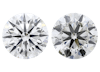
The left HPHT diamond has top cut, colour, clarity, polish and symmetry grades with no fluorescence. The diamond on the right has far lower grades, appearing dull, yellowish and clunky. Queensmith's gemmologists would reject the diamond on the right.
Lab diamonds vs moissanite: What's better?
Moissanites can look starkly different to diamonds and therefore are often labelled as fake diamonds, or diamond simulants. On the contrary, lab diamonds are entirely real, and look identical to natural diamonds - but thanks to the efficiency of their production, they retail between 50% to 60% cheaper than mined diamonds. Lab diamond rings are a far better option than moissanite rings when it comes to a tighter budget.
Moissanite isn't specifically graded on the Gemological Institute of America's (GIA) diamond colour chart, but it generally mirrors a GIA-certified K-colour diamond. Most people could tell the difference between a colourless D to F graded diamond and a K grade, which will appear yellow or greenish.
Whether you choose moissanite or diamond, both gemstones offer unique advantages and appeal to different preferences. Moissanite appeals to affordability, brilliance, durability, and ethical considerations, making it an attractive option for budget-conscious and environmentally-conscious individuals.
Diamonds, on the other hand, are classic, rare and enduring symbolism, backed by their exceptional durability and resale value. Ultimately, the decision lies in aligning your personal priorities with the distinct qualities of each gemstone.
Choosing the perfect gemstone in Hatton Garden
At Queensmith, each of our consultants are trained gemmologists, with the expertise and passion to create the most exquisite engagement rings and wedding bands at the best value for money. If you’d like a little more information, know exactly what you want, or would like to hear from the experts, we’re here to help – just drop us a message.
Intrigued about our ring-making process? You are invited to explore our ring workshop to see the artistry behind every stunning piece of jewellery at Queensmith. Book an appointment to find out more.

Moissanite vs diamond FAQs

Do you have additional questions? No problem, let us help you through the process
Yes, with care. Moissanite is hard enough for everyday wear and won't lose its colour or go cloudy. Over many years its facet edges can show fine wear sooner than a diamond's would, and, like any ring, its claws and band will need regular checks.
It depends on what matters most to you. Moissanite costs less than a diamond of the same size and is durable enough for daily wear. However, it doesn't look like a diamond. Its sparkle is more colourful, and it can look slightly tinted, especially in larger sizes. If you want the look of a diamond at a lower price, a lab grown diamond is worth comparing.
Yes. At 9.25 on the Mohs scale, moissanite is one of the hardest gemstones, so it copes well with the knocks an engagement ring gets every day. Whether you like its look is a more personal question, so try to see moissanite and diamond side by side before you decide.
A lab grown diamond. It has the same hardness as a natural diamond, 10 on the Mohs scale, so it resists scratches and wear better than moissanite over the years. Both are durable enough to wear every day.
Most gemmologists would say no, mainly because of how it looks. Moissanite gives off a colourful, rainbow-like sparkle that some people find less natural-looking, and its facets can appear less crisp. A diamond has a bright, white sparkle and sharp, clean facets. Moissanite is also slightly softer than diamond, so it's a little less resistant to wear over time.
The main downside is its appearance: moissanite's strong rainbow flashes look different from a diamond's sparkle, and larger stones can look tinted or slightly hazy because moissanite is doubly refractive. It's also a little softer than diamond (9.25 on the Mohs scale against 10), so it's slightly more likely to show wear on its facet edges after many years.
Do you have additional questions? No problem, let us help you through the process


